Wednesday, June 20, 2018

Kids???

I joke that I spend half my time worrying about where to live, and half my time worrying about having kids. Hah! It's really more like 90% about kids. (I can worry about multiple things at once.)

Blogging tends to help me organize my thoughts, so here we go.

Should one have kids?

Well... from the perspective of the world at large, I don't see many reasons for/against. I guess overpopulation is a thing, but the US is below replacement. Like, it's imperialist and paternalistic and etc, but the way to stop overpopulation is not for you or I to have zero kids instead of two; it's to make sure that, throughout poor countries, people have contraception and personal security and stuff. Yeah, your kids will eat food and cause greenhouse gas emissions, but you've got to think that the world's better for you being in it, and therefore it hopefully will be for your kids too.

From the perspective of the not-yet-existing kids, I don't see many reasons for/against either. I tried to see the point against it! But it doesn't ring very true, if you read that post. Even though I may rather never have existed, I think most people are pretty happy to exist. Therefore, I don't think you're doing a bad thing by having kids.

So it seems like whether you should have kids is all about you.

Points in favor of having kids

  1. Maybe you just want to. If this is the case, there you go! That's easy, and you can stop reading here. I'm going to write the rest of this assuming you, like me, don't have this inherent drive that some people seem to be born with.
  2. It's new and unique. I'm not being glib; this is a very good reason. Same reason I like traveling. Spending a month wandering around India is not more pleasant than being at home, but it's new, and it's worth it to try new things. Expands your world.
  3. Old age insurance. You can't necessarily count on your kids take care of you, but I imagine it's nice to grow old with kids.
  4. Potential grandkids! This sounds great.
  5. It's a chance to perpetuate your values at least one more generation. I mean, if you think your values are pretty good (and I do), you might want to do that.
  6. See the world through kids' eyes. If you're feeling old and jaded (yep!) maybe having a kid around will make you want to finger paint or play with legos or something again.
  7. Unknown upsides. Like, people say things like "you can't imagine what it's like to have kids." One friend said of her daughter: "I didn't know what it was like to love someone so much I want to eat her." I would like to know what that's like!
  8. I think most people who have kids are pretty happy to have them. Even big nerds like me!
  9. Even if the truth is "kids suck, but parents don't admit it"... I'm generally a fan of placebos.

Points against having kids

  1. I mean, the usuals: sleepless nights, diapers, angsty teens, etc.
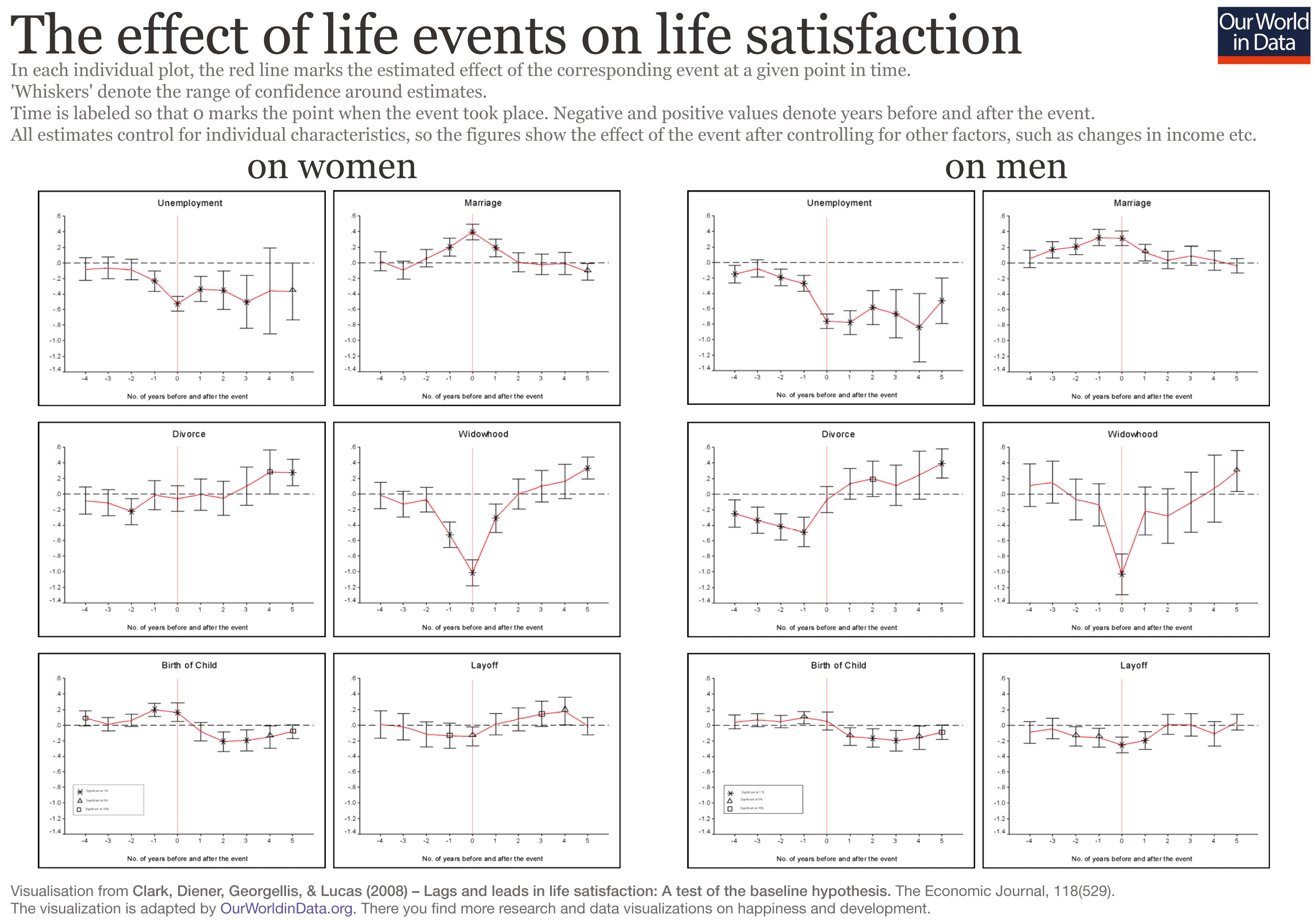
  2. But seriously; take a step back and look at #1 harder. Your life satisfaction will go down. Life satisfaction isn't just your day-to-day happiness. It makes life harder in a way that isn't necessarily "beautiful struggle." This cartoon. (warning: creepy, not funny.)
  3. Loss of freedom to travel or take whatever job or join the Peace Corps or whatever. Having kids expands your life in one way, but cuts off opportunities for you in other ways. Also constrains where you live a bit.
  4. Relatedly, costs a lot of money.
  5. You can't really go back and un-have kids.
  6. Opens yourself up to more risk: I understand your child dying is basically the worst thing that can happen to anyone. Right now, I can't know that level of grief, but if I have a kid, I could. (This is not a huge point because "better to have loved and lost", but it is a point.)
  7. What if your kid has severe autism or something? You have to at least listen to this podcast before you hype up kids to me.

What am I thinking?

The "in favor" point #2 is the most convincing to me. In the same way that I'll travel around the world for no real benefit, or try meditating or whatever to expand my human experience, I might as well expand my experience by trying having kids. Plus point #7 (unknown benefits) - maybe they're the same thing. #8 helps; if I'm an average SSC reader, something like a 96% chance of being at least neutral on the decision (and over 50% chance of 5/5) feels pretty good.

Having kids does cut off certain possibilities in life - but I wasn't doing them anyway! Seriously, the path I'm on is "white collar corporate job and traditional marriage." Not saying this is bad or good; I have very many feelings about this (best served in another post or series of posts)... but it is about the easiest path to have kids on, so might as well.

The rest of the upsides and downsides kind of even out. You make your next five years worse in order to make your future years better. Maybe it's the biggest challenge you have left in life - and in that case, how exciting to get to the top of the hill!
(maybe "over the hill" means not that your life is over, but that you get to bike downhill from here and it's pretty great.)

I don't know what to do about the severe autism or the possibility your kid might die. I guess you just hope it won't happen - and it probably won't. I might get hit by a bus tomorrow and be paralyzed - what happens if I increase my odds of "life-altering terribleness" from 0.00001% to 0.00002%? Meh.

Still, it feels like everything adds up to about a -1 on a scale of -10 to 10, with a standard deviation of about 20. It feels hard to imagine how good or bad it'll be. Or, let's be honest, on the basis of feelings it feels like about a -5, because I viscerally feel all the downsides. But on the basis of thoughts, it's +4. I think it's maybe a tiny bit unwise to have kids, but I'm pretty much completely uncertain about it.

(When I mention this to people, they're like "what??? but... you're still planning to have kids?" 

Anyway

Talk with me about it? It's about the biggest thing left in my life I will ever need advice on, probably, so I would love to talk with as many people as possible. If you're interested, I will find time to phone with you.

Sunday, June 10, 2018

I wanna be the very best, like no one ever was

Magic cards!

(background: I loved Magic cards (wiki) when I was a kid. In college, I stopped because I didn't want people to think I was a big nerd. About 10 years later, a lot of my friends who were also big nerds, but less afraid than me to say so, got back into it, so eventually I did too.)

I have a love/hate relationship with it. I really like playing the game - it's like a drug; it's got the deepest strategy of any game I've ever really gotten into. I really like my friends who play the game. I don't like the average person who plays the game, or the average situation in which you play the game - usually it's a large, loud room with a bunch of 30 year old nerdy white guys. So like, on the one hand, ugh.

On the other hand, one thing I've learned growing older is that it's okay, and even Good, to be a huge nerd. (for some definitions of the word "nerd.") Follow your bliss, and all that.

So there's a big tournament coming up (Grand Prix Las Vegas) and I'm going there mostly to hang out with my friends, and I decided, screw it, I'm gonna actually practice this time. So I put in an embarrassing number of hours on uneventful nights and weekends playing 95 matches of Magic Cards on the computer.

(yeah I went 60-35, ending up with a rating of 1791, and didn't even have to buy any cards - though pulling two Karns and a Teferi helped with that. anyway, yes I'm kind of proud, thanks for asking)

What did I learn?

1. I do like it. It's very fun.
2. It gives me something to talk about with these few friends. Unfortunately, most of them live out of town. But the tournament next weekend should be fun.
3. I like winning, and I dislike losing, more than seems healthy. When I quit after a 3-0 draft, I'm just constantly replaying in my head all the great decisions and sweet cards I got. When I quit after a 1-2 (or worse: 0-1 in the comp league), I'm really frazzled and frustrated. It makes me want to get back and get that next hit.
4. Relatedly, I tilt sometimes. Hopefully this immersion has gotten me a little better at seeing that and dealing with it.
5. Magic Online's not a great human-relationship-bang-for-buck, at least not where I am now. There's only so much talking online about the cards you can do. I imagine if you had a lot of friends who all played, near you, and you saw them in person it might be more fun.
6. I do feel like the time's wasted. I want to de-weight this, because 32-year-old Dan knows that your life doesn't have to be one big college resume anymore, and doing something you love doing is kind of one of the things that life's about.

So, would I do it again? Meh. Like a drug, I found it sapped my will to get out and do other things. That seems like a bad direction to go further. And I think if I'd been winning 40% instead of 60% (and blowing through a couple hundred dollars) I'd feel much worse about the whole thing.

EDIT, after the tournament: that was fun! I went 9-6 at the tournament; 6-3 on day 1 (sealed) and 3-3 on day 2 (draft). I was a little bummed especially about my second draft, where I drafted bad wizards and went 1-2. But overall semi-proud of my performance. One win away from a pro point, three wins away from money. More importantly, had a great time with my friends.

Does this change how I'd think about it? Yes, especially because this is exactly how well I've done at a previous GP where I didn't practice at all, and because my friends who are better than me at Magic did about the same. 30 drafts in one season isn't gonna make me better, or give me a richer experience. Given that I'm never gonna do 300 drafts, I'm just "doomed" to be a "decent" Magic player. That's fine; enjoy the game.

Edit again: a couple extra thoughts about the tournament:
- I like the adrenaline and focus you get from doing this one very engaging thing all day - and the mental stretch. It feels like running a marathon for your mind.
- The camaraderie is cool too - you're all fighting for something together.
- The sense that, in a million different places throughout the world, 3000 people are getting together to nerd out about the same thing, and each of these niches is so complex. We have so much shared knowledge about the cards, the rules, even just the etiquette of each game; so many people must be doing the same thing. It's like sonder.

Thursday, June 07, 2018

politics sucks

Whenever I try to debate most anything, if I'm being honest, I haven't a dang clue. It requires learning details of how a law works, what its probable effects would be, a lot of history, and/or what a candidate stands for. Best I can usually do is proclaim my group allegiance, state a vague version of what my side usually believes and what the other side usually believes, and why I think my side's better.

It seems to me that a sane thing to do would be to research a few issues, and take a stand, and then be able to debate them confidently. Then shrug on most anything else and just try to learn from anyone stating any opinion, the best I can.

However, that sounds like a lot of work, and after my day job, I have no energy to.

Some things I'm thinking about doing:

- just skip the "research some issues" and only learn from people. Just like, every political conversation is a chance to open my mind. The downside: I think most people's opinions are about as informed as mine, which is to say, not very.

- listen to more podcasts. The ones that I feel like I sometimes learn something about The World from: Econtalk, Conversations with Tyler, the Sam Harris one, On the Media, and sometimes Decrypted. I would like more like this; please recommend me some.

- read more blogs. Slate Star Codex is worthwhile. I would like more of these too. The Weekly Sift is a pretty well-researched news blog, but it does just make me mad about everything that's going on.

- take Twitter app off my phone. Tweetdeck is actually a somewhat sane desktop Twitter UI: just shows you all the posts in chronological order. Twitter Android mostly does that, but also has ads, and also shows you things your friends liked. (That's terrible. If I wanted my friends to see it, I'd retweet.) As a result, I can get sucked into the clickbaitiest culture-warsiest post any of my friends liked.

- move off Twitter too and onto Mastodon? This solves a different problem (that Twitter Inc's interests are not aligned with ours) but it's one that's worth solving.

One worry I have:

- do these proposals just entail retreating? Does this just mean that even less informed people will talk more than me? Is this irresponsible? (maybe it's good though! retreating from useless noise is probably healthy.)

Monday, May 28, 2018

some links

Predictive drawing with neural networks
This is one of these things that I saw once and can't seem to find the exact same gif. It was like, you'd be drawing, and it'd be showing you the most likely continuations of the current line you're drawing.
Anyway, this predictive-drawing is a really useful idea I've had reason to reference; I wish it had a simple name.
One application: sometimes in conversations, when people are not very direct, you have to do this kind of "predictive drawing" in your mind to fill in what they're saying. Like if you're in a work meeting and someone says "I don't know if this is the best thing to do here," it becomes all of the following:
- I don't want to do this
- I would like to do it, but I honestly don't know if it's the best thing to do
- I kinda want to do this, but I'm expressing hesitation because I don't want responsibility for decision making
- I actually can't do this because of some secret political thing that would be impolite to bring up
etc.

The 9.9 Percent is the New American Aristocracy - Yes! Remember: inequality is because of the 0.1%, and you, you fellow 9.9%er, you are not them. You are not going to become them. You will not get ahead by sucking up to them. The 90% are your people.
Also this thread. Especially: "(So if you want my take on living up to democracy, it does require acting as if ordinary people are not dumb. They are not. They are constrained. There is a difference. It matters.)"
Again, Fox News is at least one big part of the problem; if there's an industry (created by the 0.1%) telling the 90% how much the 9.9% looks down on them... well, it's not going to help anything.

How to have meetings well, in lots of detail. I mostly agree with this - there's bits I'd quibble on, but it does seem a lot more mature than the strategy I learned at Google, which was "basically you should never have meetings."
(this is hyperbole; google was somewhat smarter than this and continues to get smarter probably, but that's how I compressed this into my mind)

I started using Duckduckgo ("The search engine that doesn't track you") a couple years ago, kinda on a whim. It's totally great; I probably get bad results and then try google, like, 1 in 100 times. (and google fails sometimes then too!) You might as well use Duckduckgo too. An easy way to do so, it seems, is to get their new browser extension.

Sunday, May 27, 2018

CA voting, part 2

(here's part 1)

Hard to find guides for CA-wide races! Here's the Chronicle. Here's one from Planned Parenthood. Here's the SF League of Pissed-off Voters for the "progressive" vote; useful because when even they endorse moderate candidates, like Padilla and Yee, that seems good.

Governor: I think Villaraigosa here, because it's a top-2 primary. Newsom is going to win first (and I'm planning to vote for him in the real election), but Villaraigosa and republican Cox are in a close race for second, and I'd rather have Villaraigosa than Cox.
Lieutenant Governor: doesn't matter much. Ed Hernandez seems fine.
Secretary of State: Padilla
Controller: Yee
Treasurer: Ma
Attorney General: Becerra

Insurance commissioner: (shrug) Lara I guess
Board of Equalization member: Not voting
US Senate: De Leon, as he's farther left than Feinstein. Hate to be ageist, but... Feinstein's policies were built in an age of Reagan and Bush 1. This feels about right.
US Rep, District 12: Shahid Buttar. Again, top-2, so obv Pelosi will win #1 but who do we want to win #2? I've seen ads for Jaffe, but... construction moratorium and no congestion pricing -> nope. Similarly with Khojasteh: "the US is in the midst of a housing crisis driven not by lack of supply but by surplus of greed" - no! that is exactly the opposite of what is true! Buttar is at least not as wrong.
State Assembly Member, District 17: Chiu's been good, let's keep him.
Judge, office 4: Cheng (background for these 4 judge races)
Judge, office 7: Karnow
Judge, office 9: Lee
Judge, office 11: Ross
Superintendent: Thurmond

Mayor: see also part 1; in short: Breed.
District 8: I'm kinda undecided now. (Chronicle editorial.) When a "moderate" organization endorses a "progressive" candidate, that sounds good. And Mandelman's really putting in the effort, while Sheehy's kinda not. But ... Mandelman's "solution" to the housing crisis is "more rent control"? Well, plus "more affordable housing", which we all want of course, but his policies might make harder to build. Ehh. Doesn't really matter; we're going to rehash this one in November anyway.

State ballot propositions: turns out these are easy. (more info)
68: Yes
69: Yes
70: No
71: Yes
72: Yes
Regional prop 3: Yes!
City and county props: see my part 1 (in short: yes on ABDEFG, no on CHI). I changed my mind to vote in favor of E just to spite the tobacco companies who have sent me so many mailers against it.

Tuesday, May 22, 2018

what are your feelings axioms?

Having feelings is hard. Making decisions is hard because having feelings is hard. Reasoning in ways that will be good to your future feelings seems hard.

But a lot of our feelings are pretty reducible to other feelings. It feels possible (and would be great) if you could reduce all your feelings to a set of axioms or values or something.

Here's my attempt for mine:

1. Universal kindness. I think a good measure of this is: do you act like everyone is exactly as much of a human as you? This is basically the Golden Rule.

2. Logic. I hesitate to include this because it seems like it could be co-opted to just mean "be a weirdo robot Spock who devalues feelings and stuff", but I'm not sure how else to say it. You've got to be committed to seeking truth, avoiding cognitive biases, and being epistemically humble.

3. Curiosity. I think you should keep looking for new things you like, or delving deeper into the things you already do like.

4. Self-motivation. Plus points if you do things that you like! Minus points if you force yourself to do things. Another way to think about this is moving through the world somewhat easily and calmly, not fighting everything all the time.

5. Health. Physical, mental, emotional, social.

If I'm correct, this list encompasses everything I believe pretty well! But I'll be looking for examples of what I believe that is not entailed here.

Sunday, May 06, 2018

San Francisco Voting in June

I mostly follow these, from SF Yimby.
I also try to follow these, from SPUR.
The SF Bike Coalition is mildly important to me.
And if I hear anything Scott Wiener endorses, I'm inclined to vote for that as well.

Ultimately, we're in a housing crisis here, and we have to build a million billion units of housing starting 30 years ago. This is the thing that colors my votes more than anything else. I'd say I'm a single-issue voter, but housing affects almost everything else; the housing debate IS the gentrification debate, the homelessness debate, the transportation debate.

As a result, I fall right in line with the YIMBY faction. SB 35 is great and already making housing work; SB 827 would have been awesome, and the only things I hear against "build more" are of the following forms:
1. "Let's not displace people (esp poor and nonwhite ppl) who are here now." I agree with this! That's an important concern. And seems like we can work that out while also building more. SB 827, for example, added a bunch of tenant protections after discussing with people who might get displaced. If you want to talk about displacement a lot, but not build more, then I have to assume you're "bootlegger and baptist"ing - saying you support X for "good" reason Y, but you actually have self-interested reason Z.
2. "I don't want things to change." This has 2 forms:
2a. "I want SF to still be a cool artsy funky hippie whatever alternative place like it used to be." Well, uh, it's not 1967. And in the words of the wise sage Geddy Lee, "if you choose not to decide, you still have made a choice." By not building more, we ensure that things will continue changing in the way they are now, and SF will be even richer and whiter and more boring.
2b. "I want SF to be precious Victorian houses, not Manhattan." I mean... I get that, but I just think it's way less valuable than the alternative. When it's "I like Victorian houses" vs. "SF is a homelessness war zone that you can only afford if you make over $100k, and barely then", scrap the Victorians.

How I'm voting, as of now, assuming I hear nothing else. Numbers indicate how much I care about each, on a scale of 1-10, where 1 means "I barely care enough to check a box on this or I'm very unsure about it" and 10 means "this is the most important thing ever"
Mayor: Breed, then Leno, 8
Rep: Sheehy 5
Regional Prop 3: Yes 8 (tax bridges, fund transit)
City propositions:
A. Yes 5 (utilities bonds)
B. Yes 3
C. No 1
D. Yes 5 (C and D are kind of a bummer; I'd take $70m for housing before $140k for childcare, but... it's not an easy choice.)
E. No 1 (Did somebody say, grape blunt?)
F. Yes 8 (legal representation if you're getting evicted)
G. Yes 8 (tax for teachers)
H. No 9 (Tasers)
I. No 1 - even though I support it in principle, saying "we shouldn't court sports teams" doesn't actually do anything.

There's still a lot to do, mostly at the state level, so I'll probably post again about those when I figure them out. Anyway... /r/changemyview.

Sunday, April 22, 2018

Emotional classical music

Let's assume, for this conversation, that Mozart > Bieber:
For this post, I'm going to assume a simplified account of musical taste which is not exactly what I think about music (or at least it might lead you to assume certain things about music that I don't believe), but it's a pretty conventional trope so it makes the analogy easier. I'm assuming that there's this "classical music", Mozart and Beethoven and stuff, and then there's "pop music", Justin Bieber or whatever. When you're a kid, you like pop music, because it's sugary and dancey and addictive. As you get older, you maybe start to appreciate classical music more - it's not as immediate, but it's deeper. Arguably, the joy that a music lover gets out of a wonderful classical music concert is better* than the joy a kid gets out of Justin Bieber.

Aspiration vs. Ambition:
Podcast interview between Tyler Cowen and Agnes Callard. (If this link works right, it'll take you right to "on aspiration and proleptic reasons"; if not, do a command-f for that.)

Worth a read or listen, but my short summary: Ambition is just "wanting stuff." (s/stuff/prestige, or status, or money, or a Justin Bieber CD, or whatever.) Aspiration is "wanting to want stuff." Like, I don't really want tickets to the symphony, but I want to be the kind of person who wants tickets to the symphony.
(Callard says that you can only really aspire to want "good" stuff, but I think that's unnecessary - first of all, people don't tend to aspire to like "lower" pleasures", and second of all, "good" is a little arbitrary.)

Another essay by Callard. An excerpt I love: if you have a friend Phil, who just likes donuts and reality TV and other "low" pleasures, but you're trying to open his eyes to "better" things, what you are asking him is "to try to believe them to be more valuable than he has currently has reason to, in order to learn their true value."

Emotions in place of music
Ok, I was just watching Saw (bear with me here; also goriness alert; also mild spoilers) so I was watching Saw** and the guy is like "I have to help my family enough that I'll even saw off my own leg to help them." And it's not even just "give up your foot", it's like "give up your foot and hope that you don't bleed to death and hope that you don't get otherwise killed etc, given that you've been trapped by a sadistic serial killer" - it's like "probably give yourself a painful death, in order to maybe help your family."

If I were his family, I'd probably be like "dude, don't worry about it, don't saw your leg off; either we'll find another way out of this or else we'll probably die anyway, b/c serial killer and all; you don't have to saw off your own leg in the off chance that it'll help us." But you don't start a family because you want them to be loved; indeed, half of your future family doesn't even exist yet! You start a family because you want to love them. You want to feel that love that's strong enough that you'd saw off your own leg to help them.

Let me try that again, with a less morbid example:
When you were a kid, you learned that getting Christmas presents was great! The older you get, the more you realize you actually prefer giving presents. It's a harder emotion to get into, but it is deeper and more satisfying.

So what do we do?
Is it good to aspire to liking classical music, or to aspire to liking gift-giving over gift-receiving? Well, good for whom? I think it's ultimately good for you if you aspire. But it might just be natural. Like, if you're satisfied by donuts and Bieber, go for it. The only danger comes when you don't know that you'd be happier if you aspired higher. Like, if you just get bored and depressed with Bieber, but you don't realize that there's a better option out there (though it does take some work).

Also, how do we aspire? I like Callard's concept of "proleptic reasons" - you can have your cognitive part know something that your feelings side doesn't know, but the feelings side lets you back into it. Like, you can think "classical music is really rich", but that won't make you actually start doing it. But maybe you start dating someone who likes classical, so you go with them because you're into them. Then over time you start liking classical for its own sake.

A neat corollary:
This may have something to do with the length of life that you've experienced. If your life is 5 years long, the thrill of getting presents might last you through that! If your life is 50 years long, you realize that the constant sugar high gets old, and you want something that's more complex and lasting, so you skip the Bieberesque gift-giving and go for the Mozartian gift-receiving.

What if our lives get longer? Do we get into more complex emotions? I'd have to think so. And that if you're 1000 years old, you could have some really-complex really-wonderful emotions that look super alien to a younger kid, kind of like how enjoying Mozart can feel impossible to a kid.

Footnotes
* one of the best moments of grad school, in retrospect (though not at the time) was when we had to go around the room and describe our research to professor and design researcher John Zimmerman in a class. Everyone else in the class described their stuff, and he was like, "ok." When it got to me, I mumbled something about "studying social media in cities in order to make cities better." And he just started asking me "what do you mean by "better"? Better in what way? Better for whom?" and I was totally taken off guard, because I admittedly had no good answers. Then I got mad because I felt like he was singling me out. But he was definitely right: "better" is a cop out when you don't know what you're talking about. Most things will be better for some people, in some ways, and worse in others.

** ok, two more asides:
1. this movie was way better than I expected. I mean, low expectations, and it's not a masterpiece, but it was a solid low-budget suspense-thriller. (that somehow got Cary Elwes, Donald Glover, and Ken Leung? Maybe not super low-budget. Felt like it though.) Unlike how it was described, it wasn't just a torture-porn-fest (though there was a solid 10 minutes of that).
2. I have to point out how this movie is oddly appropriate to talk about in a conversation about high/low culture :-P

Saturday, April 14, 2018

Links Roundup

Name of the Year is going on now, down to the Sweet Sixteen. Current status:
- Bulltron Regional is a powerhouse. Looks like Salami Blessing might edge out Miracle Crimes (fair enough) but Mosthigh Thankgod might take a fall too, which is surprising. Jimbob Ghostkeeper is a pretty good name though. I would send any of these to the final four; pity only one can make it.
- Fruithandler and Dragonwagon regions are less exciting. "Megha" is far enough from "Mega" that Dr. Megha Panda is not quite as great as our other two amazing animal names. I guess I'd go with "Delicious Peters" over "Chardonnay Beaver" but in both cases I am snickering like a 12 year old.
- Chrotchtangle Regional has my two favorites: Dr. Narwhals Mating and Dr. Taekwondo Byrd. Mating is still my pick for the overall winner, and is sailing past Beau Titsworth, but Byrd is in trouble.
Get your votes in!

I should probably gather supplies for when an earthquake hits, and this seems a decent guide.

Peter Norvig's Pytudes - I thought "I should do some of these", because fluency, esp with Pandas and python plotting, would be really nice to build. However, they're not about that. However however, they are pretty cool. I expect I would have spent a lot of time on these if I were in college or something.

Kevin Love, Cleveland Cav, opens up about panic attacks and anxiety. Respect. And "everyone is going through something" should probably be a constant motto in the back of everyone's head.

Janelle Shane is still one of my favorite bloggers. Here she collects a bunch of "neural networks beating the system" examples.

This takedown of Chick-fil-A is mayyybe a culture wars guilty pleasure, but I loved the writing:
"The air smelled fried."
"David Farmer, Chick-fil-A’s vice-president of restaurant experience, told BuzzFeed that he strives for a “pit crew efficiency, but where you feel like you just got hugged in the process.” That contradiction, industrial but claustral, is at the heart of the new restaurant—and of Chick-fil-A’s entire brand."
"Most restaurants take pains to distance themselves from the brutalities of the slaughterhouse; Chick-fil-A invites us to go along with the Cows’ Schadenfreude."
"Homogeneous food is comfort food, and chains know that their primary appeal is palliative."

A mostly... interesting?... take on consciousness, AI, and "being human": it's mostly about being wrong all the time. I don't know if this is factually accurate (or indeed, if it's pinned down enough to even be falsifiable), but it's a kinda cool literary look at our minds. Helpful reminders: 1. we *are* wrong most of the time, 2. we're more like a city than a computer, 3. "The only reason I can think of to build [self-conscious] machines is to employ more shrinks."
Helpful reminder that could have been added: strong AI does not necessarily mean "thinking just like humans do."

Could I do a links post without linking to a Slate Star Codex? Probably, but not this time. Recommendations vs. Guidelines - or, if that title is still as opaque to you as it is to me, consider it "recommendations vs. decision (and action) trees." I want decision/action trees for everything in my life. I want to know not only "what is the best toothpaste," but "what's the decision tree for toothpastes." The Wirecutter/The Sweethome are good at this, and sometimes I find a good guide elsewhere (like this for depression.) I should start keeping a folder of these or something.

(btw my current toothpaste decision tree is: "do you get canker sores? if so, then find a no-SLS (sodium lauryl sulfate) toothpaste, like some of the Jason or Sensodyne ones - but make sure it's still got fluoride. SLS is actually bad for canker sores, but fluoride is good for your teeth, and only tinfoil-hat types think fluoride is bad. If you don't get canker sores, any fluoride toothpaste is fine. Colgate Total at one point had an extra active anti-gingivitis ingredient that my dentist said was good, but who knows, they might all have that now." Ideally I would also have links attached to this decision tree! But I don't; and maybe that is why people don't do this, because writing up-to-date well-researched decision trees is hard.)

Friday, April 13, 2018

I listened to Sam Harris and Ezra Klein debate because I'm kind of dumb

You can too, if you're so inclined: https://samharris.org/podcasts/123-identity-honesty/. If you're not, please ignore this whole thing; I kind of wish I had all this time back. However, maybe it helped me crystallize some of my thoughts around the issue.

Why care?
I care about the issue of "this white guy's life got ruined by Political Correctness!" because I feel like I am one of the people who should be most sympathetic to it (white/male/every privileged status you can imagine, and very much into logic and clear thinking), and I'm not very sympathetic to it. As a result, I feel like I have a nonzero obligation to talk about it. (Kinda like how the onus is really on the sane "never-Trump" conservatives to speak up these days. Your fellow GOPs (and members of congress!) who enjoy the Trump garbage fire will never listen to a bike-riding techboi from San Francisco, but they might listen to you if you have historically cared about things like "fiscal responsibility" and "acting like adults." But I digress.)

Anyway, yeah, I got to it through Harris's podcast, which I recently started listening to, because he talks about interesting things. But man, he sounds really bad here.

Background: Sam Harris had Charles Murray on his podcast like a year ago. Charles Murray wrote a book like 20 years ago in which he talked about how maybe white people and black people just have different IQs. His, uh, career has suffered because of it; he's still (sometimes violently) protested when he comes to give a talk on college campuses. Ezra Klein wrote some articles excoriating Harris for having him on. Feud, etc, and they eventually got around to having a discussion on each of their podcasts. Like, props to them for getting to that point.

Harris's take: yes, racism is still happening and we need to fix it, no arguments there. But Murray's book is just science. Maybe the fact about IQ is true, and just by bringing it up, Murray got his life ruined. This is not good; we need free speech, not "politically correct" mob justice.

Klein's and my takes, and I credit Klein with articulating most of them better than I could have:

1. Science is usually not a "disinterested list of facts." That is almost never the case. Sam, you're a philosopher and a PhD, you should know that. Even choosing what facts to research is not disinterested. (To Harris's credit, he apparently grilled Murray on this - "why even study racial differences in IQ?" He doesn't agree with Murray, he just thinks Murray shouldn't be so vehemently shunned.)

2. Murray is not a disinterested observer who wrote down disinterested lists of facts and got his life ruined. He's a longtime conservative think-tanker. After arguing "black people have lower IQs", he went on to argue "well, black people are poor, nothing we can do about it, oh well; cut all these social programs." Casting him as this unlucky fact purveyor is far too generous.

3. White people through the ages keep studying stuff like this, finding "huh, white people are just better than black people, it's just science." Obviously, every time, they're being idiots, and attributing things to innate genetics that are better attributed to the fact that white people forcefully subjugated black people and installed hundreds of years of laws to ensure that they remained second-class citizens. Therefore, if you're going to argue "huh, white people are just better, because science", it's on you to prove why it's different this time.

4. Harris gets very frustrated whenever anyone resorts to "identity politics", but doesn't realize that he, too, plays identity politics. Why does he care about Murray? Murray's in his tribe: white men who might say "politically incorrect" things. Klein kept bringing this up, Harris kept denying it.

5. "Political Correctness can go too far, but it probably isn't this time." - My Law of Political Correctness I Just Made Up. Corollary: if you're going to argue "PC has gone too far", you have to hold yourself to a very high standard. You have to be incredibly pure of motive and strenuously consider that you might be wrong. Murray doesn't and isn't. Furthermore: every time you argue "PC has gone too far" but you're actually being a goon, you make it harder for the next time someone has to argue "PC has gone too far."

So, similar to that time I got in an argument with other people I listened to on a podcast, my conclusion remains "Yes, I'm sympathetic to the argument that Political Correctness might go too far, and cause real harm. But this guy is not your poster child!"

Did I read Murray's book, listen to Harris's podcast, or read Klein's articles? Nope. Feel free to take this blog post with as many grains of salt as you like. Anyway, whew, got that out of my system; still wish I had my time back, but what can you do.

Tuesday, April 03, 2018

Writing about suffering to understand what I think about it

Podcast interview with Dan Pink, pop-psych author; mentioned how he finds writing a book proposal really helpful because it helps him think about a thing. It's not that he does all the research and then writes it down; writing the book proposal is part of the research.

(That's kinda a purpose of this blog, which maybe I had never realized until now.)

---

I don't know what to do with suffering. Here are two seemingly-opposing points of view:

1. Suffering is just bad; you should try to avoid it.
2. Some suffering can be good.

Ok, obviously not all suffering is good - if it were, I should be flagellating myself in the streets. There is some suffering that is just stupid. So that leaves us with, "can suffering be good?"

Points for "yes suffering can be good":
- Viktor Frankl
- the Catholic Church
- "better to have loved and lost than never to have loved at all"
- some kind of gut feeling that I can't really explain; but my basic morality was very informed by Methodists and Catholics so I don't trust this very much

Points for "no, suffering can't be good":
- well, the obvious: it feels bad! and if it feels good (say, if you're a masochist), it's not really suffering then, is it?
- by what mechanism can suffering be good?
- the idea that suffering can be good can keep you from alleviating your suffering. Or, "of course The Man wants you to think suffering is ok."

What are some examples of suffering that is good?
1. You are working hard on a project, but you finish it and you've done a great job! Your hard work involved suffering.
2. You are caring for a beloved family member dealing with a sickness, and it's hard, but they appreciate it and you are helping them feel better.
3. That family member dies. You feel very sad.

In case 1, would it have been better if you hadn't suffered? I mean, say the outcome is the same. Maybe it wouldn't mean as much to you. Like, if you're a kid on the playground trying to dunk a basketball and it's really hard but you keep practicing jumping and you finally do it, that's the best day of your life! If you're Lebron and you dunk, whatever.

In case 2, what if you didn't suffer? Like, you help them, but it's really no skin off your back. Maybe they're not as close to you then? They appreciate it, but they know that it's easy to you.

In case 3, what if you didn't suffer? I guess if you just shrugged and said "whatever"... well, everyone would think you're a monster, but more importantly maybe you'd have been missing out on a deep relationship.

---

Frost and Fire is a short story by Ray Bradbury that I keep coming back to, mostly for one scene. In this world, the sun is very very hot, and so there's only like an hour at dawn and an hour at dusk where the outside is habitable; otherwise it's skin-meltingly hot and people live in these caves. When they have to settle a dispute, instead of physically fighting each other, the two combatants will just stand outside at dawn and suffer as long as they can; first one to go back inside loses the dispute.

Evolutionary biologists (I think) talk about "costly signaling": mates are attracted to animals with very visible negative traits, because "I can survive even with this bad thing" suggests "I am very fit." Something about big antlers or something - doesn't really help, just makes life difficult, but if you can deal even with these antlers, well, you must be a real prize.

Economists would talk about costs too, and I don't know how, but there's some idea of raising costs for things. Like, congestion pricing in cities ("everywhere you might enter central London in a car, you have to pay a $20 toll"). That's just worse for all the drivers - but makes for a better city overall, even if they just burned the collected tolls. Sometimes we can inject suffering into a system that didn't have it before, and it will make the city run better.

None of these are really justifications for suffering, as a human; you're not going to win a fight or find a mate or get less traffic just because you suffered. Actually, none of this may be related to the conversation at all. Makes me feel clever, though, to talk about it.

---

Another wrinkle about suffering comes from the Buddhists. AFAIK, they all tend to make an important distinction between pain and suffering. Pain is just pain; suffering is all the stuff our conscious mind layers on top of it.

For example, you stub your toe on a table leg. "Ouch!" is pain. "I'm so stupid, how could I have not seen that table leg?" is suffering.

Getting good at dealing with suffering (and lessening it, by not shooting more arrows at yourself when you do get hit by an arrow) is maybe the entire point of Buddhist teaching.

(obligatory IANABuddhistTeacher)

So instead maybe we should be asking "Can pain be good?" And of course, yes it can; it makes you get your hand away from the hot stove. It might even be good in stuff like case 3 above, with the family member dying. I've had painful experiences that I wouldn't want to undo; somehow the feelings, however painful, seem worthwhile.

Similarly, if you imagine the Buddha, I don't think he'd see a family member die and go "whatever, no problem!" I think he'd be very sad. I guess he'd just avoid any shooting-more-arrows-at-himself.

---

I don't have any great answers here, but bringing them all together:
- sometimes physical pain is good
- sometimes emotional pain even is good, like the family member dying
- adding suffering and second arrows to it maybe isn't useful
- did I just talk myself into just accepting the Buddhist position whole hog?

How can I apply it to my immediate problem, which is that my cat Humpty won't shut up and keeps waking me up at 6:30am?

I guess, just deal with it - the pain may help me deepen my relationship with cat; laughing about it may deepen my relationship with Tati; gives me something to make small talk about at work. At least, it's interesting. That is how I think about these things when traveling: even the dumbest and worst experiences lead to great memories. At any rate, avoid second-arrowing, like "will he ever stop meowing?" or "why did we even get this stupid cat?"

You know how, when you exercise a lot, you hurt but it feels virtuous? Maybe that's what I ought to start doing about pain in general. Like, with cat making me sleep-deprived, maybe I just try to say "yep, I am dealing with this pain; it is making me stronger/wiser/better, or at least making a good memory."

(That's kinda nauseatingly cloying. Still the best answer I've got, though.)

Sunday, March 18, 2018

It seems valuable to blog when an art really jumps out at me

In this case, it's Annihilation.

Sci fi/horror movie about an area in Florida that has become kind of shimmery, and nobody who goes in comes back out.

So good! Tense, disturbing, thoughtful (though, many questions and few answers), trippy, beautiful sound/music, wonderfully monstrous creatures. Soft sci fi about "what if mutation got cranked up to 1000?", and a soft psychological thriller about "why do people self destruct?", all in one.

Riyl: mother!, Sunshine, Ex Machina (same writer/director), Alien, Black Swan

Also, video game that continues to stick with me: Crypt of the Necrodancer, in which I finally finished an All Zones run with every character except Aria (f that) and of course Coda. Jeez, I can't imagine an All Characters run; it'd take hours of perfection.

Saturday, March 17, 2018

I oughtn't even *blog* about Terry Gilliam

Like, I sweat Gilliam's movies pretty hard. Ask Tati about Brazil. I like it much more than I should. I'll go out of my way to tell you how good The Imaginarium of Dr. Parnassus was. So the news that he's being a jerk about women and #metoo is pretty sad. I was gonna write a clever tweet, and then realized, nope, tweeting is really the worst response to something like this. So I spent more time to write more of a blog? *sigh* I guess it's just that, because I sweat his movies, I feel a need to say something, when I don't need to say anything about, say, Woody Allen.

I can't find the full interview. Here's the best subset I could get.

"the #MeToo movement has morphed into "mob rule"" - no, stop. mob rule is when people get killed, not when people say mean things about überfamous Gilliam and Damon for a couple days, and Gilliam and Damon go on with their übersuccessful lives.

"Weinstein "is a monster" and that there are "plenty of monsters out there... There are other people (still) behaving like Harvey" in the film industry, abusing their power for sex." - I am confident this is true!

"But Gilliam said the reaction against the wave of sexual abuse and harassment revelations had become ugly and "simplistic... people are frightened to say things, to think things." - uhh - like, this statement is true, but tarnished by the fact that most people saying it are being assholes.

"It is a world of victims. I think some people did very well out of meeting with Harvey and others didn't. The ones who did knew what they were doing. These are adults, we are talking about adults with a lot of ambition.
"Harvey opened the door for a few people, a night with Harvey -- that's the price you pay,"" - are you insane? justifying sexual-favors-for-success?

"the atmosphere around #MeToo has "got silly, people are being described in ridiculous terms as if there is no real humanity left anymore.
"I feel sorry for someone like Matt Damon who is a decent human being. He came out and said all men are not rapists, and he got beaten to death. Come on, this is crazy!"" ... uh oh, I think you're either straw-manning Damon's critics, or motte-and-baileying.
(side note: Matt Damon said some things that I agree with and some things that I don't. He looks a lot better than Gilliam in this situation.)

"I know enough girls who were in Harvey's suites who were not victims and walked out." - yeah, and Jeffrey Dahmer didn't murder everyone he knew.

"It's crazy how simplified things are becoming. There is no intelligence anymore and people seem to be frightened to say what they really think. Now I am told even by my wife to keep my head a bit low" - well... I guess your old beliefs are becoming unacceptable? And given how crummy they are, I'm ok with that? I agree with your point that everything is just knee-jerk good-or-bad these days. But we need a better arguer against this tendency.

"It's like when mob rule takes over, the mob is out there they are carrying their torches and they are going to burn down Frankenstein's castle" - no, it's like if the mob got real mad at Frankenstein for a couple days and, like, didn't buy his movies on Amazon or something.

---

And why the hell am I blogging about this? Why did I let you take an hour (or more?) of my day, you old goat with crummy old goat beliefs? And why is everyone who's saying "let's stop the witch hunt" acting so much like a witch?

I guess it's just another point in favor of the idea that you can argue difficult things publicly, but you gotta be superjesus. Gilliam, you have some points, but you also have a lot of antiquated and/or otherwise shitty beliefs; so as a whole, best to keep them to yourself.

Monday, March 12, 2018

Also, forget David Benatar

I heard him on Sam Harris's podcast (who I also have mixed feelings about but often agree with) and Harris had basically the same issue that I did: "you're kinda just proclaiming The Asymmetry."

Refresher: Benatar's big "asymmetry" is like this: good experiences are good, and bad ones are bad. The absence of bad things (if a person didn't exist) is good, but the absence of good things (if a person didn't exist) isn't bad because there's nobody who's around to miss the good things.

My and Sam's response: what the hell! You're just saying that. We can just as easily say "the absence of bad things isn't good, because there's nobody around who's not experiencing bad things."

If you don't accept The Asymmetry, most of the rest of his book doesn't add up. (You could instead be all Buddhist-ish and say "life is always just negative things; the best you can do is have no negative things", which neatly solves some population ethics problems still, but I don't think I believe that either.)

Also apparently he wrote this too, so, uh, that's embarrassing.

Friday, March 09, 2018

A hierarchy of hard problems as a human

Being an adult has a lot more upsides than being a kid. It's kinda harder too, and in different dimensions than being a kid was hard. Like, it's not like "do some math or something, but better" - it's like the qualitative shift when you realize that being very good at math won't help you with your relationships.

Unfortunately, it seems very hard to even understand what any class of problems is about, until you get there. For that reason, I feel pretty confident about the early ones and not at all confident about the later ones.

Class A1: Requires work or IQ. Example: grade school
Class A2: Requires work and IQ. Examples: college, some jobs
Class A3: Requires work, IQ, and some kind of skill at defining problems. Examples: grad school, some other jobs
Class B2: Requires work and emotional intelligence/EQ. Examples: normal human relationships (easy friendships, say), some other jobs, being a happy and sane human if all's going well.
Class B3: Requires work, a lot of EQ and/or self-knowledge. Examples: more intense relationships, being a mental health professional, being a happy and sane human if all's not going well.
Class C2: Requires work, EQ, and IQ. Example: managing people at a job.

And then there are some others farther down the list (C3? D3?):
- being fulfilled/flourishing
- being a parent?
- some kind of enlightenment/awakening

Anyway, who knows if this kind of framework is useful at all. I guess I'm just trying to justify why things are still seem difficult, even though I've had a decent amount of practice at a lot of things, and hopefully built up some skills by now!

Sunday, February 11, 2018

Arguing online: you can do it, but you gotta be Superjesus

There should be a code you can adhere to in order to signal "I am sincere, and probably not going to make things worse." Something like this:

The Code of Superjesus
- I might be wrong.
- I am not trying to win an argument; I am either trying to educate or trying to get to a further shared truth. (if I am trying to educate, I will be very careful that I'm not being a jerk and offering unwanted advice.)
- I realize that all the people involved in this argument are real people, and I will make an effort to imagine that each of them is a person I respect.
- I will give everyone involved as much benefit of the doubt as possible.
- I will make every effort to avoid a common set of logical fallacies. (Maybe we could use the Illustrated Book of Bad Arguments for starters.)
- I will not offer unfalsifiable claims.
- I realize that I must be even kinder online than I would be if I were having this argument in real life.

I wonder if this has been done. Recurse Center's manual comes to mind ("no feigning surprise", "no well-actuallying", "no subtle isms", etc). I bet the Lesswrong folks or some other online rationalists have done this too. I mean, to be clear, probably every successful subreddit or other online community has something like this (and I bet I know some online-community researchers, so if you know this, shout it out). I think I'd want it to be one step less connected to any one community - so I could say "Code of Superjesus in effect" and link to it and people could know what this means.

(Of course, that would then make it one more (unofficial) community and in-crowd. Oh well.)

Tuesday, February 06, 2018

It's the end of the world, and I feel fine?

Starting soon after the Trump election, I started posting, then curating/coordinating, a daily email list of advocacy things. I also subscribed to a bunch of podcasts and news sites (NYT, Economist, Pod Save America and then Pod Save the People, More Perfect, 538 Politics, and a bunch of email newsletters I'm still trying to get out of.) And I tried to get involved with some political organizations, most actively Indivisible and then Sister District.

Starting about 3 months ago, I haven't been doing any of that. (Except the podcasts. Some of them.) And I have two main feelings about this:

1. happy to have so much time and brain space back
2. vague feeling of dread that I'm not addressing something that I should be, as if my doctor said I have cancer and I'm just ignoring it

I keep seeing worrying signs of slides into fascism in the news. Trump flouting norms and then laws (Russia sanctions, Mueller investigation meddling) and his congress buddies just going along with him. Onetime anti-Trumpers (Lindsay Graham, John McCain, Jeff Flake) making big speeches and then just voting with him all the time anyway. It's not Trump that worries me; he's an idiot. It's the fact that all his boys are content to let him take whatever power he wants.

At the same time, I kiiinda can't do anything about it. My experience over the past year has done... nothing? I mean, I got some nice form letters from Pelosi Feinstein and Harris, so I guess some intern tallied my calls/emails. I gave some money to some small candidates in close races across the country. I guess I'm doing my part and that's ok? Like, if Trump becomes Hitler*, I guess I'll look back and say "why wasn't I out in the streets every day?" but otherwise in the meantime I've got to live my life.

I don't have anything smart to say about this. Just, it's a bit tiring to live like this.

*what would this even mean? would this be "when we have concentration camps, gestapo, and laws banning ethnicities"? I mean, Guantanamo, ICE, and Muslim Ban, right? Sure, they're smaller in scope, but Hitler didn't show up on day 1 and say "let's kill all the Jews;" it happened slowly.

Sunday, February 04, 2018

What if Christianity didn't depend on magic?

Christianity has a lot of good things about it, a lot of Christians are wonderful, etc. As a highschoolman, I talked to some teachers (some of whom were priests) and tried to figure out if I should do this Christianity thing. Ultimately, they insisted that to be Christian you kinda have to believe in some of the base theology, mostly that Jesus rose from the dead and ascended into heaven.

Believing that Jesus rose from the dead and ascended into heaven appears to me to be totally nuts. For comparison (and forgive me if I'm (ahem) preaching to the choir): imagine I told you "There's this guy Zorgo, who was a really great guy, and he could levitate in midair. Therefore, he is a supernatural being and you should worship him. We know this because Zorgo's followers wrote down in a book, 2000 years ago, that Zorgo could levitate in midair. Plus, Zorgo has lots of followers now and they all believe it. Some of them even had visions of Zorgo levitating."

(If there's an epistemological subtlety that I'm missing, honestly, let me know! I see no way you could be someone who wants to see the world clearly, and also believes that Jesus rose from the dead and ascended into heaven. But I do pride myself on being openminded, so if you have a case that suggests that I wouldn't be a fool to believe in Jesus, while I would still be a fool to believe in Zorgo, I would honestly love to hear it.)

Naturally, this kind of turns off a lot of people. (Especially nerdy people, who tend to move to big cities and work in thinky office jobs and get rich and etc, and here's your urban/rural divide, etc.)

Could Christianity exist without it? Like, why not just have a religion that's something like:
- love thy neighbor as thyself
- here are some stories about the Israelites and stuff, they are mostly some good lessons about how to be good
- here are some stories about this guy Jesus, he was a very good guy, you should be like him
- here are some mystics throughout the ages, they have some more reasons that it's good to be like Jesus
- being in a community of equal people all seeking meaning and virtue is good, you should probably do that

(... does this exist? is it Unitarian Universalism or something?)

Wednesday, January 31, 2018

Better never to have been?

(feel free to apply Betteridge's Law)
(also: note that I discuss nonexistence, and suicide in passing, and if you'd rather not read about that, maybe skip this post.)

I read this article, and I had one of those moments where I felt like I finally connected with someone, or some intellectual subculture, somewhere, that I didn't previously know existed. I had to get his book.

The book in question, Better Never To Have Been by David Benatar, tries to make the case that existence (as a human) is worse than nonexistence, and then explore what that means. I... kinda agree? So I read this book. Here are my thoughts.

Disclaimer

Before we go further, I think I should make it very clear that I'm not at all suicidal. This post is in no way a cry for help or anything. I'm trying to approach this question coldly and intellectually; it is no more about me, personally, committing suicide than a Trolley Problem discussion is about some urge to commit vehicular manslaughter. Besides, even if existence is bad, suicide is way worse. So, don't worry there.

(if you are in that place, though, maybe try the suicide prevention lifeline? https://suicidepreventionlifeline.org/ or 1-800-273-8255. Also, I'm always willing to talk about depression and stuff, and non-judgmentally, and I won't jump to any conclusions or anything; I'm not a professional, but if you want to talk, you can reach out to me.)

Existence. Is It Bad?

I'll try to lay out Benatar's argument, and then my reaction.

Benatar's argument for why existence is bad

Basically, pains are worse than pleasures. Why are pains worse? Because the absence of pain is good, but the absence of pleasure isn't bad.
Imagine 2 scenarios: in scenario A, I exist, and in scenario B, I never existed. In scenario A, I have some pleasures and some pains; some good and some bad. In scenario B, I don't have any pain (that's good!) but I don't have any pleasures (well, who cares? I don't exist.) Therefore, scenario B will always be better.

He presents this as an axiom, referring to it as "asymmetry." He says, if you disagree, well, ok; but you probably agree. Here are 4 examples in which you probably agree:
  1. If person X said, "I've got a rare genetic disease that would make my kids suffer a lot and die, and therefore I won't have kids," you'd say "yes, that makes sense." There's a responsibility to avoid theoretical beings' suffering. But there's no responsibility to provide theoretical beings' pleasure; if X said "eh, I've got a nice house and no genetic diseases; if I had kids, they would probably be pretty happy," you wouldn't say "X, you have a responsibility to create some happy kids."
  2. He has a #2 example, but it sounds to me just like #1, so I'll skip it.
  3. If person X said "I regret bringing my son into existence; he had a sad, miserable life," we would nod and say "hmm, bummer, but I agree." If X said "I regret not bringing my son into existence, he would have had a great life", we'd say "huh?" We can't really regret the absence of pleasure, but we can regret the presence of pain.
  4. If I said "there are people on Mars, and they are suffering!" you would say "bummer for them!" If I said "no, just kidding, there are no people on Mars", you would say "whew! I am glad they're not suffering." If I said "there are no people on Jupiter, and therefore they're not enjoying their lives" you'd say "well, ok, I don't care." This shows, again, we regret present suffering, and we celebrate both present pleasure and absent suffering, but we don't regret absent pleasure.

Some other arguments he brings in too


Shiffrin's punch-for-money argument

We allow people to inflict pain in order to reduce future pain. (Say, you might have to pull out a tooth so that it doesn't cause more pain down the road.) But we don't allow people to inflict pain in order to cause pleasure, without permission. Imagine if I said "I'm super rich and I like punching people, so I'll punch someone, but then I'll pay them $1 million. I think the pain of the punch is not as bad as the pleasure of $1 million, so it's ok." But you still wouldn't say I'm ethical; it still feels wrong. Now, if I made a deal with you, and I proposed "let me punch you, and I'll give you $1m", and you said "OK, it's a deal", then this is ethical. But it wouldn't be ethical if I didn't ask your permission first.

When you bring a baby into the world, you're doing exactly that: you're saying "I'm going to cause some suffering and some pleasures for this baby by making it exist, and I think the pleasures outweigh the pains, but I couldn't ask it whether it wanted to do that deal," and therefore it's unethical.

(I made up this name; neither Benatar nor Shiffrin call this the "punch for money" argument :P)

Fehige's frustrationism argument

This guy says life is not ups and downs, it's just wants/needs that either get satisfied or frustrated. When we say we're happy, we mean "a need got satisfied"; when we're unhappy, we mean "a need is unmet." Therefore, if a person exists, they will be satisfied sometimes and frustrated sometimes; but if they never existed, boom, no frustration, so no problems!

This sounds like Buddhism to me too: life is dukkha; life is suffering/difficult. You can stop suffering by reducing your clinging to things.

The quick healing person

Imagine two scenarios: you get sick a lot, or you never get sick. And imagine you either have a superpower that you can heal quickly, or you don't have that power.
1. You get sick a lot, and you can heal quickly: this is fine.
2. You get sick a lot, and you can't heal quickly: ugh!
3. You don't get sick ever, and you can heal quickly: this is fine.
4. You don't get sick ever, and you can't heal quickly: this is fine.
Suffering in life = getting sick; pleasures = healing quickly. Cases 3 and 4 are analogous to never existing; cases 1 and 2 are like existing. Life's pains are like getting sick; life's pleasures are like healing.
This argument feels a lot like the frustrationist argument.

Life's worth is not just additive - and even if it were, it'd fall short.

You don't decide whether a life is good or bad by just adding up all the good parts and subtracting all the bad parts. I mean, do you? Is that how you experience life? Probably not. Even if you did, look back at your day; probably most of it was in the negative. And your negative/traumatic experiences loom way larger than your really good ones. I mean, maybe you're one of the rare people who have a positive sum; in that case, imagine that 90% of the world is negative - would you want to bring a baby into the world with a 90% chance they'd have a mostly-negative life?

My reaction

Benatar's argument isn't ironclad. I really wanted to be convinced, but his argument bottoms out to a bunch of "well, it sure seems like..." points.

The Asymmetry Point

He ... kinda just says this whole asymmetry thing, and I'm not sure if I'm on board. Maybe we should be regretting pleasures missed, or nonexistent people on Jupiter who can't experience the miracle of life. Or maybe the absence of pain is only "not bad", it's not "good" - after all, it's not happening to anyone.

But I feel you, David! Look at all this dukkha!

I mean, life is kinda a series of suffering! Isn't it? Sure, there are good things, but... having an ego is a solid trip to finding things unsatisfactory! I challenge anyone who disagrees with me here to spend more time with their own thoughts. It's kinda nuts in there.

However, the Remembering Mind

Daniel Kahneman points this out most clearly and popularly (quick article). We literally experience the world in two very separate ways, the Experiencing Mind and the Remembering Mind, and the Remembering Mind has some weird biases. For example, we'll go on a vacation during which we're kinda miserable, sick, sleep-deprived, over-touristed, and just crummy 95% of the time, but we'll only remember that great 5% and say it was a great trip.

By extension, say your whole life is that vacation. Benatar would say "Look at you! You're really mostly miserable!" But at any point he says that, your Remembering Mind would take over and says "nah, my life is pretty good. Look at (great thing X)! See, I'm happy."

Who's to say that that Remembering Mind is wrong?

Similarly, ok, I've got low-grade chronic depression, so I can kind of see life as being a constant struggle/frustrated desire/suffering/dukkha. But if I asked 100 people, probably 90 would say "nah, my life is pretty good." Even if it's not their experiencing mind talking, who am I to tell them they're wrong?

So, all in all, I'm not really any more convinced that existing is bad for everyone.

I mean, I think it'd be better if I hadn't existed. (refer again, if you like, to the above disclaimer about how I'm not suicidal.) I don't have high confidence in that, though; I'd guess that the net Goodness of my existing is a normal distribution centered at -0.1, with a standard deviation of 1. So, I could easily be wrong; ask me again in 10 years.

Regardless of whether I think it'd be better if I hadn't existed, I don't think I've learned anything about whether other people would be happier if they never existed. I imagine a very happy, fulfilled person reading this book and saying "meh, I disagree on your premise, it sure doesn't feel right to me," and I don't have a ton of great ammo to convince them.

Some easier side points that Benatar and I agree on


Suicide is bad

As bad as existing is, suicide just makes things worse! It's probably really painful, and it sucks a lot for everyone around you. So, Benatar argues that you shouldn't create more kids, but given that you already exist, you'll cause more suffering by killing yourself than if you just let yourself live normally, so don't kill yourself. I agree on this.

It's not just dumb pleasure and pain here

Not just talking about ice cream vs. electric shocks. Whenever I say "pleasure", replace it with whatever you think is actually good, like falling in love or enjoying a sunset or being one in ecstatic union with your deity of choice or something. Whenever I say "pain", replace it with a terrible breakup or losing a loved one or whatever else is actually painful. Related:

There's no "meaning" that you can jump to to get out of this one

Well, I mean, maybe there is; if you're convinced that Jesus is God and that makes your life meaningful, don't let me talk you out of it. Or if you think you exist for the glory of Allah, or you're just part of Vishnu's plan, or you really get meaning from your Shinto deities, great! But some of us aren't so lucky. And if you're not, either, then it's kind of a dodge to say "well, life maybe isn't pleasant, but it's meaningful." Define your meaning, and tell me how that makes life worthwhile, and then we can get somewhere.

Anti-natalism (Benatar's belief) does neatly solve the Repugnant Conclusion

Derek Parfit talks about the Repugnant Conclusion, which goes something like this: Say you have 10 people on Earth, and they are all living great lives; 100 happiness points each. If we want to maximize total happiness, then you'd say surely it is better to have 11 people with 99 happiness points: 99*11=1089 happiness points total, instead of 1000. And therefore, 15 people with 98 happiness points each would be better still. How about 1 million people with 10 happiness points? That's 10 million total happiness! or, 1 billion people, each with 0.1 happiness - that's 100 million total happiness!

But I can't imagine the world with a billion people, each of them living lives that are barely worth living, is better than the world where 10 people live 100-point great lives. But, if you're a strict "maximize total happiness" utilitarian, the math works out. Therefore, "the 1 billion people world is better" is the repugnant conclusion.

If you instead look at every life as some amount of negative, it works out great. A very good life is maybe only -0.1 points; a -100 point life would be very bad indeed. Therefore, you want to decrease total misery, not increase happiness, and the mathy conclusions fit with our intuitions.

If you agree that existence is bad, it opens up a ton more questions

Should you have kids? Should you abort them, if you're pregnant? Should we as a species become extinct, and how should we do so? These are all very interesting; I didn't really care about these chapters because I wasn't convinced by the base argument.

I'm frustrated about the typography in Blogger

I feel like I have a pretty good outline of ideas, but their hierarchy won't come across in the published post, because of relative sizes of headings or something. Eh, Benatar didn't say this, but he would.

One other side point Benatar and I disagree on

He makes a point of saying "I'm going to use 'him' for the generic singular third person pronoun." Whatever, dude. You and the Jesuits both. Language moves on, you can use singular "they" now, it's way easier. That point aside, though, I found him a pretty thoughtful and generous writer, which I appreciate.

Saturday, January 27, 2018

Giving money to people and places

Subtitle: I've probably explained all this already but money has such an effect on our world that I feel compelled to get my thoughts down again.

My relationship to money has changed over the last 5 years. I used to think "I should save money, because you never know. But I ideally want to get to a point where I'm donating about half my after-expenses money, because as a Richman in a Richcountry, we can do so much good just by tossing some money somewhere."

Now I've got a family (of two, currently, but growing at some point) so my priorities have changed: I got more selfish. I'm also in the most insane expensive city in the world.

Philosophy interlude:

I think everyone should have the opportunity to get at least 4/5 of the Maslow pyramid. Maybe all 5. Maybe all 5 plus the bonus 1! (from wikipedia I learn that there's a 6th stage, "self-transcendent needs.") For a life to be neutral, you've got to get all 5; for a life to be beneficial to the world, you've got to get self-transcendent needs too. (... or something? I don't know, but it feels about right for now.)

Anyway, so it feels immoral to bring kids in the world if I can't give them a fair chance to get to at least 4, 5, or 6 Maslow needs. In the US, that seems to mean college. (Not that it's impossible for anyone to satisfy all their needs without college, but N% of people can't satisfy all their needs without college. And N here is increasing.) So, ok, say we have 2 kids, that's $250k each = $500k. (Right now this'll just barely still pay for any school; in 20 years maybe only state schools. But it at least gives them a chance.)
End philosophy interlude! Back to practical things, like:

Owning a home

It seems financially smart, at some point. Like say a genie told me "Here's $1 million, but you must give me $1 million after you die." Great! We buy a house, and that gives me so much free money, in terms of rent we don't have to pay over the years. Say we were renting a 2br for $5k/month - that's $60k/year. If we have this magic house, it's $6k for property taxes, plus maybe another $10k for repairs and stuff and $9k for insurance - saving $35k/year, or $1.05M over 30 years. Just because we happen to have a (temporary) magic genie bag of money!
Plus, seems a good way to get fixed costs down so I can someday decide I'm going to travel for a year or something.
(Now, owning for owning's sake is another story; in that case, it's worth it if you can get all the variables right. But owning if you had a magic genie money bag, that seems smart.)

Anyway, so:
$500k for 2 kids' college
$200k for other costs of raising 2 kids (I have no idea how much this costs)
$1.3M for a house (to make numbers add up nice):
We kinda need to make $2M (if we want to live in SF/Oakland long term).

My relationship to money now:

Is more complicated? I still want to help abstract people with malaria bed nets, but not at the cost of me, Tati, or our own (eventual) kids. And, given the long-term windfall that buying a house would get us, it seems like there'll be more return, even, if I were to sell a house when I get old and donate the profits.

And life is uncertain enough, especially in the US, that having a guaranteed house seems worthwhile, so we don't get super poor and dead when we get cancer or hit by a car.

So instead of "I'll throw half my money at anything" (which I never did end up doing, anyway), now it's "I will save most of my money. But I have disposable income, and I want to donate some of it to vague good things, so I guess I've got to choose a reasonable amount and spend it kind of wisely." It seems good to have a plan?

What I mean by "giving money", and my current plan

I guess I think about this as "giving money to places without expecting a concrete thing in return." Here's what I'm thinking for a provisional split:
Bed nets/GiveWell: 20%
Patreon: 20%
Local orgs like SF Bike Coalition, SF YIMBY, SF HAC: 4%
Democrat campaigns nationwide (like the Great Slate): 8%
Friends' things: 20% (the social benefit of "you're raising money for ____! here's $x!" feels really good, and their thing probably does some good as well.)
Planned Parenthood: 4%
ACLU: 4%
News (currently Economist and NYT): 4%
TBD: 16% (for whatever comes up during the year; I can always dump it into bed nets in December if nothing new arises)

Shouldn't I be doing all Givewell?

Maybe! They are just trying to do the most good in the world. $2000 saves a life, vs becomes 0.01% of some democrat's war chest or like one meal for a bunch of artists I like (who will probably survive anyway).

However, there's one unknowable huge variable: maybe a 0.01% chance of electing one rando democrat is actually better than saving a life. Like, if you could buy a 0.001% chance of ICE not manhunting 100000 immigrants... well, that nets EV=1 life not ruined. Or the increased chance of building more housing leads to 3 fewer homeless people which leads to 1 life saved. I guess I'm just diversifying my portfolio of possible benefits.

Should I split out the arts and friends' things?

Maybe. Like, I give to Patreon selfishly. I do want to live in a world where a lot of artists make a living, but I especially want the ones I support to make a living. That feels more like "me buying things I like" than "me giving away money."

Also, the social benefit of friends' things is pretty selfish. Not that it's bad: helps me build social capital, and maybe spending $20 on a meaningful relationship is worth more than $20 to ACLU. Again, we've all got to get our Maslow levels.

Arguably the news things should go in the "arts" category, but... well, I just want to support having a real press, I don't actually read them that much.
Really, all of these lie on a spectrum. From most selfish to most altruistic:
1. General stuff I buy
2. Patreon
3. Friends' things
4. News
5. Local orgs
6. Democrat campaigns, ACLU, PP
7. Bed nets/Givewell

Anything that's in the "general stuff I buy" camp is easy to evaluate: if I want it more than I want to lose that money, I buy it.

So I guess this post should actually be called:

"how I'm thinking about spending money on stuff that's not 100% selfish."

How do I implement this?

I think, do it for a year, and try to see how it goes. If I find myself wanting to give other money that's not 100% selfish, I should still do it, and then record it, and recalibrate after a year. But, actually tracking that (like tracking anything) is tricky, and I'd be interested if any of you have any input.

(Also, if you have another way you've thought about this whole concept.)

Edit: this post by Holden Karnofsky at Open Phil is relevant and says what I want to say in fewer words; I'm trying to diversify among different world views.